
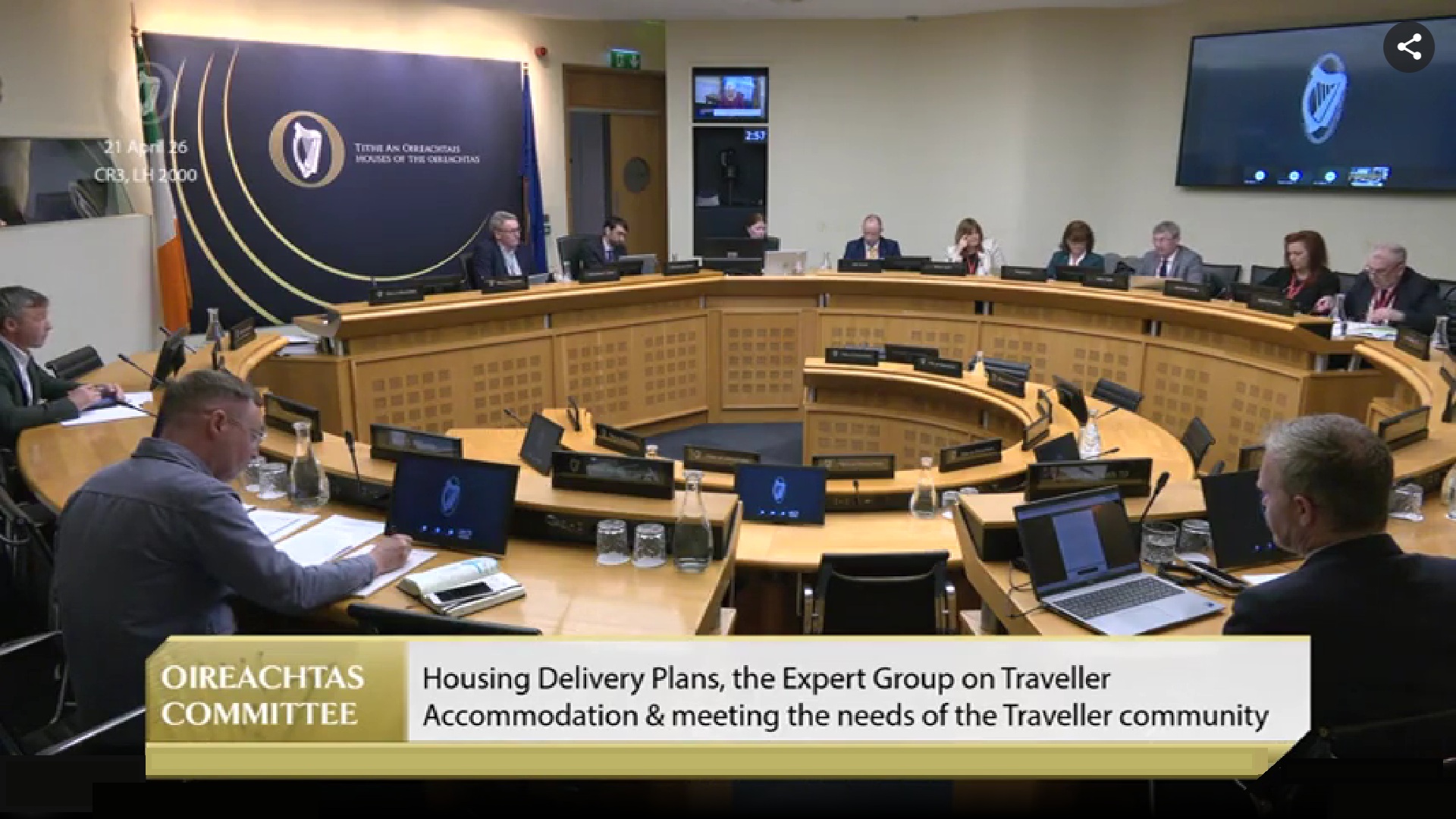
On Tuesday evening Martin Collins, Co Director of Pavee Point, addressed the Joint Oireachtas Committee on Housing, Local Government and Heritage on the question of Traveller accommodation: addressing housing delivery plans, the recommendations of the Expert Group on Traveller Accommodation, and meeting the urgent needs of the Traveller community.
In his opening statement, Martin spoke of the lack of accommodation provision for Travellers that goes back 40 years and more. In spite of the Housing (Traveller Accommodation) Act 1998, putting a legal obligation on local authorities to implement Traveller Accommodation Programmes (TAPs), he pointed to a system that is inherently dysfunctional and incapable of delivering what is required in terms of the provision of Traveller accommodation.
Underscoring the dysfunction are the 1,600 Traveller families who are homeless: amounting to 9,500 men, women and children who lack basic services, such as access to running water, sanitation and refuse collection. He stated that, ‘This is beyond a humanitarian crisis,’ and termed it a shame on our political classes and leaders that such a situation should persist in a rich developed country.
He pointed to the inherent racism in the local authority system, whereby politicians will not vote for Traveller accommodation, and reiterated the call of Traveller organisations that a national independent accommodation agency be established and modelled on the Northern Ireland Housing Executive.
He concluded by calling for the explicit prioritisation of Travellers within housing and homeless policy: supported by clear targets, timelines, dedicated funding, accountability and monitoring mechanisms. In this, he stressed the importance for the direct participation of Travellers and Traveller organisations in all planning and decision making processes.
‘Traveller homelessness is under-counted, under-prioritised and inadequately addressed’
Also giving statements to the Joint Committee were Maria Joyce, Co‑Ordinator of the National Traveller Women’s Forum, and Bernard Joyce, Director of the Irish Traveller Movement.
Maria Joyce spoke of the disproportionate level of homelessness suffered by Travellers: where Travellers make up less than 1% of the general population but account for up to 9% of the homeless population nationally, and as much as 50% in some local areas. She stated that current data systems fail to fully capture the depth of the problem facing Traveller families, where Traveller homelessness is ‘under-counted, under-prioritised and inadequately addressed’.
She pointed to a lack of funding for Traveller accommodation, which fell from €40 million in 2008 to €4 million in 2014, and rising again only to €23 million in recent years. Lack of funding is compounded by the lack of permanent, culturally appropriate accommodation, where emergency responses by private providers are preferred.
Maria finished her statement by putting two request to the Committee: ‘Make Traveller homelessness visible by properly measuring it, including hidden homelessness, so policy is based on real need,’and ‘Name and prioritise Traveller families in housing and homelessness plans, and shift investment from emergency accommodation to permanent, culturally appropriate homes.’
Bernard Joyce described the factors that underpin the structural impediments to the supply of Traveller accommodation nationally, where the lack of centralised monitoring procedures prevent an assessment of delivery flaws — perpetuating ongoing supply shortcomings and poor standards in Traveller accommodation — and where Traveller organisations are tasked with convincing government and successive Ministers of systemic blockages without access to appropriate data.
He emphasised that Traveller Accommodation is unique amongst Government Housing Strategies, in that it operates without a national strategy or implementation plan, a national budgetary plan, a centralised supply and adequacy report, or an agency with responsibility.
He concluded by stressing the need for action on governance, where local authorities can be supported by national structures, and — as previously expressed by both the Expert Review Report 2019 and national Traveller organisations — that an independent authority or entity is instituted in order to oversee the delivery of Traveller accommodation.
Read: Martin Collins’ statement.
Read: Maria Joyce’s statement.