
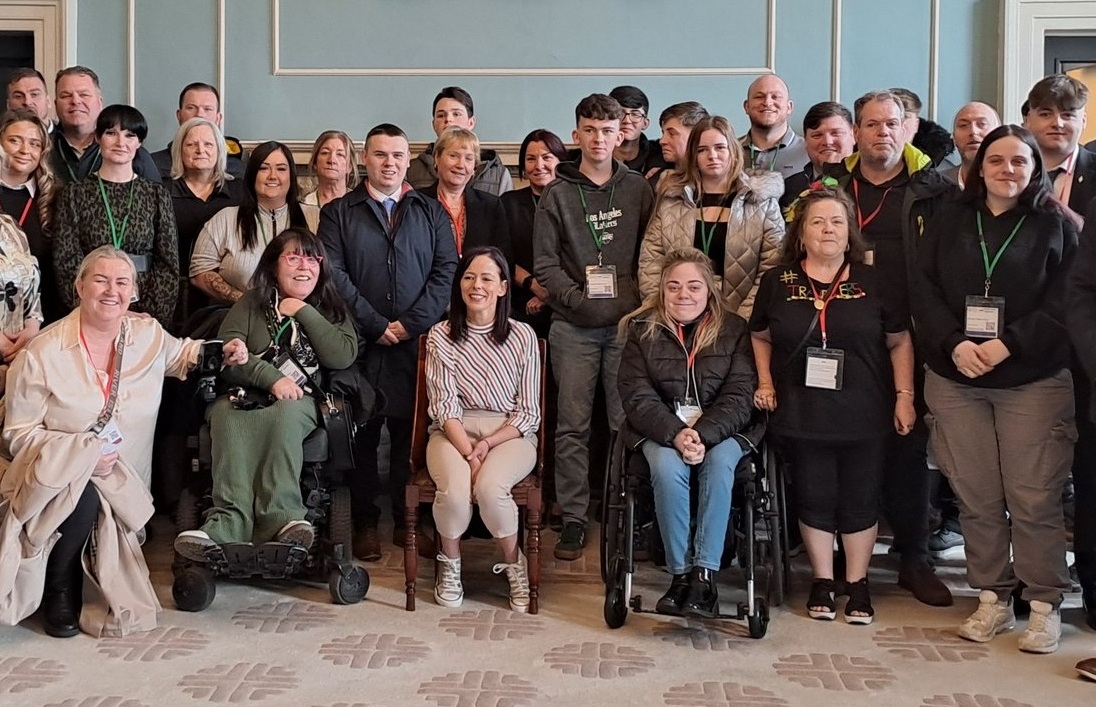
Dr Rosaleen McDonagh, Traveller woman and writer, offers insights into the complex reality of gender roles, public life and the impact of racism and sexism.
From the Inside
“Patriarchy has no gender: it is a system of power that even those it disadvantages can internalise and, at times, reproduce.” bell hooks.
The persistence of abuse and harassment in political life continues to shape who participates. For minority ethnic women, these dynamics are intensified by the intersection of gender, ethnicity, and structural exclusion. The experience of Senator Eileen Flynn, the first Traveller woman elected to the Seanad, offers a critical lens for examining these issues.
In 2016, the murder of Jo Cox highlighted the lethal potential of toxic political discourse. This event, together with documented experiences of public figures subjected to sustained racist and gendered abuse, demonstrates that hostility in political life spans a spectrum—from online harassment to physical violence. Such conditions create a chilling effect, discouraging engagement, particularly among women and minority communities. Research, including Doyle’s 2023 enquiry into abuse and harassment in political life, confirms that these patterns are not isolated but systemic.
In this context, Eileen’s election marked a historic moment for the Traveller community, generating a profound sense of pride and visibility. However, this achievement must be understood alongside the backlash it provoked. The sexism and racism directed at her reveal the endurance of patriarchal norms.
A woman who speaks out, enters public life, or questions male authority may be seen as transgressing not only gender norms but also Traveller identity itself. Powerful Traveller women—activists and leaders—often face backlash from Traveller men, who view themselves as policing cultural and gender boundaries. This backlash can take the form of reducing achievements to tokenism or using misogynistic language intended to diminish rather than engage.
The expectations placed on minority ethnic women in politics and public life are undeniably higher. They repeatedly navigate intersecting forms of discrimination, must prove competence, and often serve as symbols of progress and role models. Intersectional identities are seen as easy targets for hate, public humiliation, and ridicule.
No single person can capture the diversity of experiences, perspectives, and identities within any community or constituency. The presence of one Traveller woman in parliament, while significant, cannot address the structural inequalities that have historically excluded Traveller voices. In this sense, one is never enough. The combination of visibility and isolation creates a paradox that challenges lonely positions.
Central to understanding this hostility is the role of honour and shame within Traveller culture. Women who enter public life, assert authority, or challenge traditional expectations may be perceived as transgressing both gender norms and cultural identity. In this way, the language of honour becomes a mechanism of regulation, reinforcing boundaries and publicly disciplining women who step out of line. Shaming is used to silence. This is not unique to Traveller culture; rather, it reflects a broader pattern in which patriarchal systems utilise moral frameworks to sustain power.
It is important to avoid reductive interpretations and statements. Traveller men, like Traveller women, hold diverse political views and positions on feminism and the role of women and girls. The backlash against women in leadership does not represent the entire community, but it does highlight the tensions that arise when cultural identity intersects with shifting gender norms. Some men position themselves as custodians of tradition. Traveller identity, like all identities, evolves in response to social, political, and economic change.
In the United States, the election of women such as Catherine Cortez Masto, Tammy Duckworth, and Stephanie Murphy signalled progress towards greater diversity. Yet these women faced heightened scrutiny and abuse. Women such as Stacey Abrams and Maxine Waters have similarly encountered hostility that extends beyond political disagreement into misogyny and racism. These examples illustrate that the challenges faced by Senator Flynn are part of a broader global pattern.
Rigid gender roles are not confined to women; these proscribed expectations reduce men’s emotional range and bind them to narratives that deny vulnerability, care, and the capacity to hold complexity. If strength is defined solely as dominance and pride is tied to control rather than compassion, we are all catapulted into a realm of fear and disbelief. Women face violence, exclusion, and humiliation. Men describe this “crisis of masculinity” as a feeling of dispossession. They say this leads them to gravitate towards identities that promise certainty and power. This ideology leads to isolation, frustration, and low self-esteem, which in turn fuel anger and a persistent rampage of rage. It fosters a false sense of hubris and leadership. A moral framework that denies men permission to be gentle, self-critical, and open is vacuous and ultimately self-alienating.
Ambition in women is still treated as provocative by some Traveller men. Certain forms of ambition in women are not always understood or accepted as personal aspirations. Narratives that equate male authority with cultural preservation are dangerous. Culture evolves, including Traveller culture; it can’t be policed or controlled by those who consider themselves “true” patriarchs or matriarchs. Expressions of Traveller identity are fluid and intersecting. They must be respected in ways that align with universal ethics and human dignity. Traveller men, like all men, are capable of this evolution.
Political disagreement is an essential component of democratic life. However, it must be grounded in respect rather than humiliation or degradation. The normalisation of abuse, particularly towards Eileen and the minority ethnic women who will follow her, erodes the foundations of democratic freedom and oppresses women. When participation is associated with personal risk, the result is not robust debate but restricted access. The challenge, therefore, is not only to increase representation but also to transform the conditions under which representation occurs. The warning to women who wish to participate in public life is clear: it comes at a cost to personal safety, including that of one’s family. This is a huge compromise for women.
For our community, this means creating pathways for multiple voices to enter politics and public life. It means challenging narratives that equate cultural preservation with restricting women’s roles. It also involves dialogues that can hold complexity—acknowledging both the value of Traveller identity and women’s right to self-determination. It must allow for critique and challenge without shaming or silencing. This is the foundation of any meaningful democracy. It rejects toxic masculinity, which diminishes us all. It means understanding that pride is not fractured by gender equality and diversity; it means that Traveller identity is enriched by it.