Two new reports from the Health Research Board (HRB) point to a strong link between poverty and addiction treatment demand in Ireland and show a disproportionate number of Travellers affected by substance use.
‘An Exploration of the Relationship Between Addiction Treatment and Geographic Deprivation’, a joint project by Pobal/HRB, finds that people living in more disadvantaged communities were much more likely to need addiction treatment services. It highlights the challenges people in rural areas can face in accessing supports.
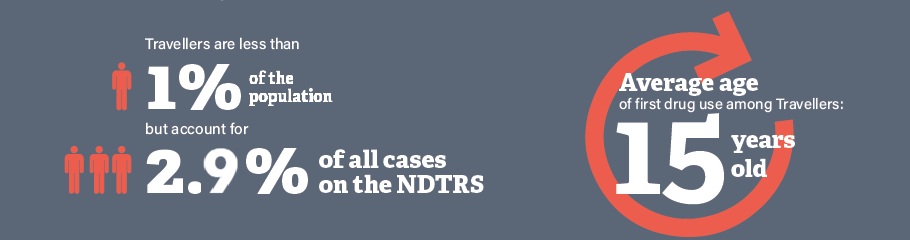
‘Drug treatment in Ireland, 2025’ finds that Travellers continue to be disproportionately represented in cases treated for problem drug use. In the report, Travellers seeking treatment for problem drug use are overrepresented by a factor of five when compared to the general population (and by a factor of ten for Traveller women). Concerningly, since 2017, the number of Traveller men and women seeking treatment for cocaine use has tripled.
Both these reports reinforce the urgent need for the finalisation of the National Drugs Strategy 2026-27: where Traveller organisations are prioritised in design and implementation, and which follows a health-led and community-based response addressing substance use and the wider causes of inequality.
While the Pobal/HRB research does not include analysis by ethnicity – a significant limitation of the Pobal HP Deprivation Index – it recognises that wider inequalities can impact health outcomes and access to services. Recent research by Pavee Point highlights the significance of ethnicity – and anti-Traveller racism – as well as poverty, homelessness and mental health inequalities on substance use and access to support.
Read Pavee Point report: ‘Traveller Substance Use in Ireland: A National Study’
Read Pobal/HRB report: ‘An Exploration of the Relationship Between Addiction Treatment and Geographic Deprivation’
Read HRB report: ‘Drug treatment demand in Ireland 2025’