
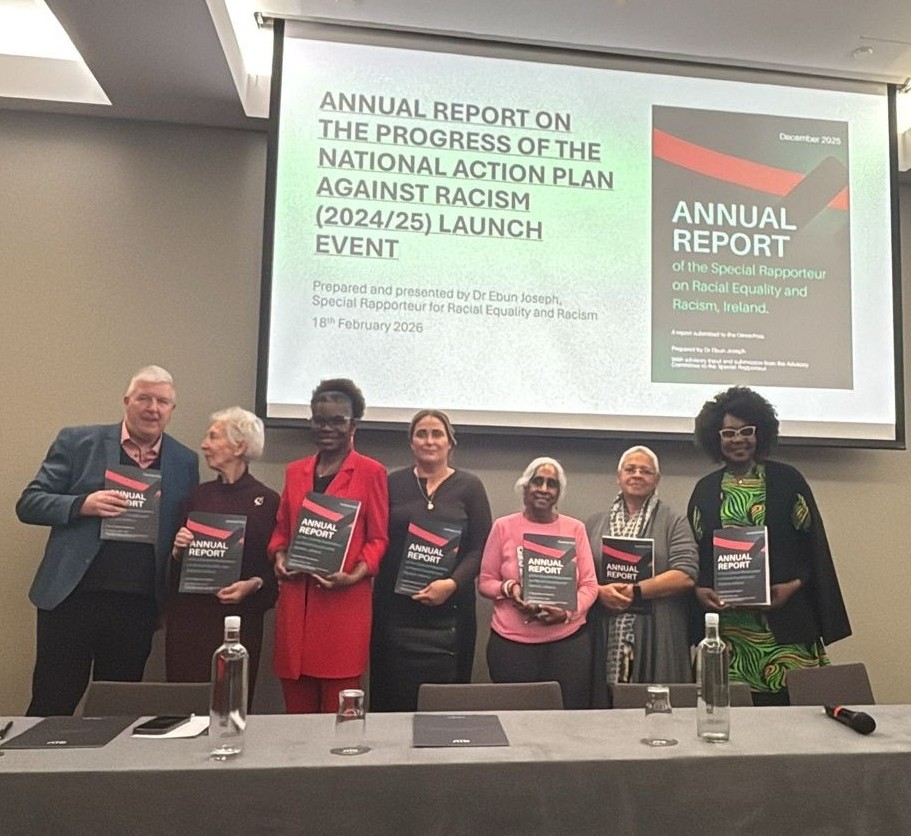
While progress has been made regarding inclusion and racial equality since the establishment of the National Action Plan Against Racism (NAPAR) 2023-2027, the pace of change is insufficient to meet the ‘scale and urgency’ of challenges to social cohesion and equality.
On Wednesday, members of Pavee Point attended the launch of the ‘Year 1 Monitoring Report’ of the National Action Plan Against Racism (NAPAR) 2023-2027: prepared by Dr Ebun Joseph, Special Rapporteur on Racial Equality and Racism Ireland.
Speaking at the launch, Dr Joseph reported that the first year of monitoring disclosed that implementation of the NAPAR remains ‘procedural rather than transformative’. Dr Joseph observed that the shift from awareness to systemic change remains incomplete.
The report calls for sustained political will, whole-of-government approach, cross-departmental accountability, robust data systems, and genuine community participation in order to translate policy commitments into tangible outcomes and to secure lived equality.
Dedicated and sustainable resourcing is needed to ensure effective oversight of the NAPAR; this will assure robust data collection, analysis and sector-wide engagement.
Given the delay in its implementation, the report also recommends that the timeframe of the NAPAR be extended from 2023-2027 to 2024-2028 in order to ensure that Ireland can deliver on its obligations, and advance towards ‘a fairer, inclusive, and anti-racist society’.
Philip Watt and Anastasia Crickley delivered the keynote addresses at the launch. A panel discussion was moderated by Dr Ebun Joseph and included Winnie McDonell; Susan T Mkhabela; Dr Philomena Mullen; & Prof Nata Duvvury.
The report makes five recommendations specific to the experiences of racism, structural inequality, and social exclusion faced by Travellers and Roma in Ireland:
Equality & Non-Discrimination: Strengthen enforcement of equality laws; fund Traveller and Roma-led organisations to support rights and participation.
Housing & Accommodation: Ensure ring-fenced and enforced spending of Traveller accommodation budgets; increase accountability for local authorities.
Education: Introduce culturally inclusive curricula; strengthen anti-racism policies in schools; ensure supports are accessible to Traveller and Roma students.
Employment & Economic Participation: Create targeted employment schemes; address discriminatory recruitment practices; regularise undocumented Roma.
Health: Invest in culturally competent healthcare services; employ and retain Traveller and Roma health community workers with better pay and conditions; disaggregate health data by ethnicity.
Specific to systemic racism suffered by the Roma community in Ireland, the report makes further recommendations:
Legal Status & Protection: Introduce regularisation pathways; ensure Roma are not excluded from essential services regardless of status.
Housing & Accommodation: Strengthen monitoring of local authority practices; sanction discrimination; increase targeted housing supports.
Education: Fund Roma education mediators; provide language support; integrate Roma history and culture into curricula.
Employment & Economic Participation: Establish Roma-specific training and employment programmes; address discriminatory recruitment; support entrepreneurship initiatives.
Health & Wellbeing: Invest in Roma health mediators; provide interpreter services; collect disaggregated health data.
Equality Data: Implement Roma-specific data collection in housing, education, health, and employment in line with human rights standards.
Full e-version of ‘Year 1 Monitoring Report’ here.
MAIN PHOTO: Philip Watt (former Director National Consultative Committee on Racism and Interculturalism; interim CEO Mental Health Reform); Anastasia Crickley (Chairperson of Minority Rights Group International; Chairperson of Pavee Point); Dr Ebun Joseph (Special Rapporteur Racial Equality and Racism Ireland; Founder & CEO Institute of Antiracism and Black Studies); Winnie McDonnell (Pavee Point Training and Education); Prof Nata Duvvury (Director Global Women’s Studies NUIG); Dr Philomena Mullen (Assistant Professor Black Studies, Department of Sociology, TCD); and Susan T Mkhabela (Cultúr Migrant Centre Community Worker).